Customer Service Interview Questions to Ask Candidates
5 core customer service interview questions to ask candidates, tied to O*NET skill ratings, with a scoring rubric, a sample scorecard and a role-play.
Oct 28, 2026 • 11 min read
Ask customer service candidates to describe real contacts they handled: an upset customer, a refusal, an unknown answer, a mistake and a full queue. These 5 questions work for support, call center and contact center roles:
- Tell me about the last upset customer you handled. What did they want, and what did you do first?
- Tell me about a time you had to tell a customer no. What did you offer instead?
- A customer asks something you don't know. Walk me through what you say and do next.
- Tell me about a mistake you made with a customer. How did you find it, and what changed after?
- Describe your busiest shift. How many contacts did you handle, and how did you keep each one accurate?
In O*NET, the US Department of Labor's occupation database, 42% of customer service representatives say they deal with unpleasant, angry or discourteous people every day, and another 36% at least once a week (O*NET 43-4051.00).
A strong answer names one real contact, shows the candidate listened before solving, stays within policy and ends with a result. Mark each answer Exceeded, Met, Partial or Unmet against the written anchors in the rubric below, so two recruiters reach the same result for the same answer.
Which skills customer service interview questions should test
Customer service interview questions should test skills and work styles that ONET rates for customer service representatives, such as active listening, service orientation, speaking, self-control and dependability. ONET rates skills by importance and work styles by impact. Firstview chose the rows that a spoken screen can test and mapped each one to a question; the mapping is our judgment, not O*NET's.
| What O*NET measures | Rating | Question that tests it |
|---|---|---|
| Active listening (skill) | 75 importance | 1, 3 and the role-play |
| Service orientation (skill) | 75 importance | 2, 7 |
| Speaking (skill) | 72 importance | 8 and the role-play |
| Critical thinking (skill) | 56 importance | 3 |
| Time management (skill) | 53 importance | 5, 9 |
| Writing (skill) | 50 importance | A written reply task for chat roles |
| Dependability (work style) | 80 impact | 11 |
| Self-control (work style) | 79 impact | 1, 6 |
| Empathy (work style) | 71 impact | 7 |
| Stress tolerance (work style) | 60 impact | 5, 9 |
| Integrity (work style) | 57 impact | 4, 12 |
Every ONET respondent in this occupation has telephone conversations every day, and 73% meet strict deadlines every day. ONET gives US data for the occupation and dates the profile 2026. The page does not state the sample size.
Speaking is rated 72, and a spoken answer to an interview question shows only part of it, so add the role-play below. Writing is rated 50, so for chat and email queues, add a short written reply task instead of another spoken question. To run these 5 questions as a live first interview with every applicant, see how Firstview handles call center hiring.
7 more customer service interview questions to ask candidates
The 7 questions below extend the 5 core questions, grouped by the skill each one tests, each with what a strong answer contains. Pick 2 or 3 for a short screen; use all of them in a longer second interview.
Upset customers and empathy
- A customer is still angry after you fixed the problem. What do you do? Listen for: lets the customer say what is still wrong and does not argue about the fix again.
- Tell me about a customer whose real problem was different from the one they first described. Listen for: the exact question the candidate asked that found the real problem.
Explaining and pace
- Explain your last employer's return or refund policy to me as if I were a confused caller. Listen for: short sentences, no internal jargon and a check that the caller understood.
- The queue is long, and the customer on the line wants to chat. What do you do? Listen for: a polite close after the issue is solved, with the waiting customers in mind.
- Which ticketing, CRM or phone systems have you used, and how did you learn the last new one? Listen for: named systems, and how long the last one took to learn and with what help.
Reliability and honesty
- This role works the shifts in the job post. Which of them can you work every week? Listen for: an exact list of the shifts the candidate can work.
- Tell me about a time a shortcut would have closed a case faster but broken a rule. What did you do? Listen for: the rule the candidate kept and how they explained the delay to the customer.
How to score customer service interview answers
Score each customer service answer on a 4-level rubric with written anchors, so "Met" means the same thing for every recruiter. The anchors below are for the 5 core questions.
| Question | Exceeded | Met | Partial | Unmet |
|---|---|---|---|---|
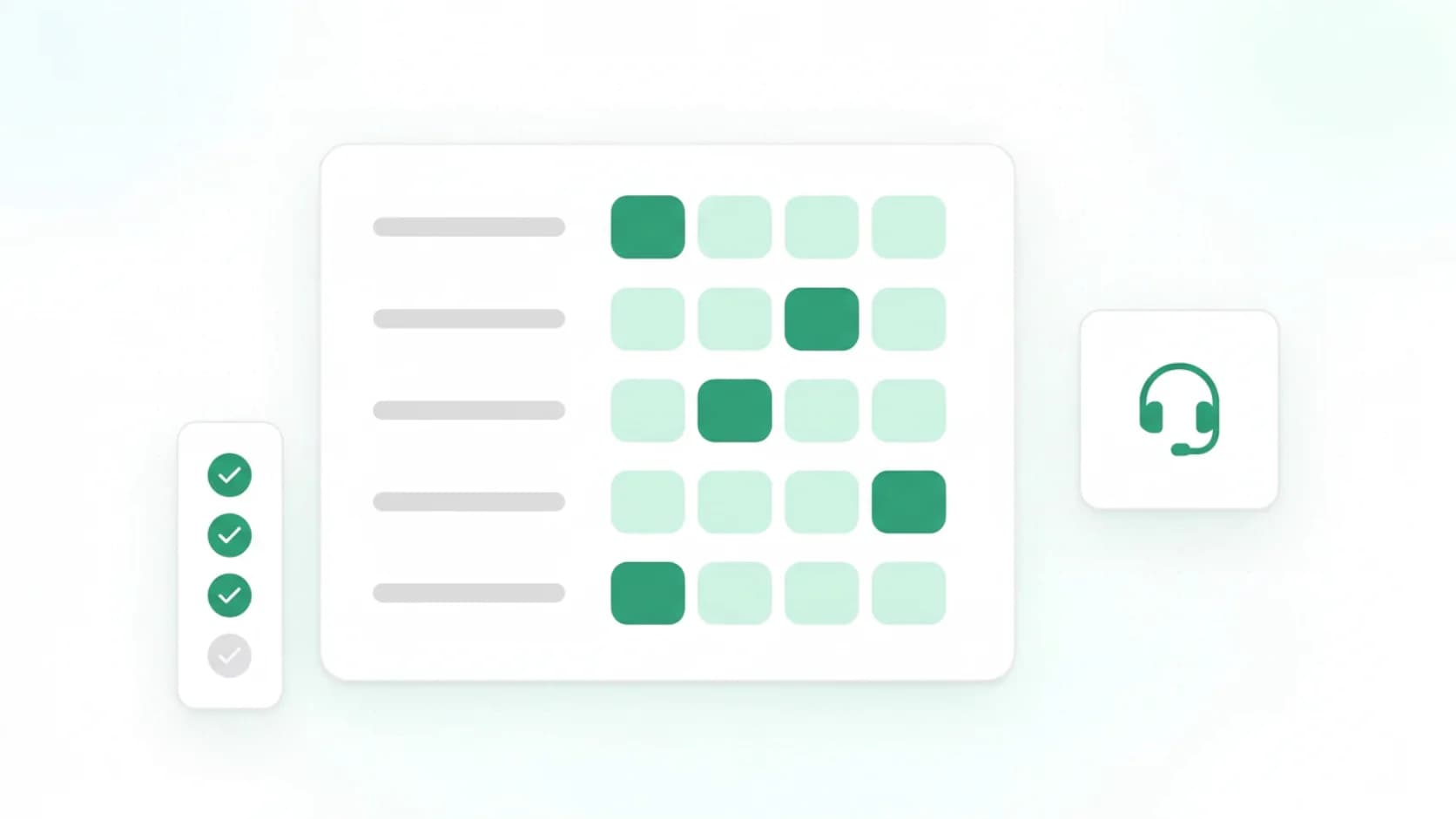
| 1. Upset customer | Lets them finish, restates the problem, fixes it, follows up | Listens first, then solves within policy | Solves it, but interrupts or blames | Blames the customer |
| 2. Saying no | Gives the reason and 2 options that meet the customer's goal | Gives the reason and 1 option | Says no with no option | Breaks policy to say yes |
| 3. Unknown answer | Says they will check, finds the source, gives a callback time | Checks or escalates, and tells the customer | Guesses, then corrects it | Guesses and moves on |
| 4. Mistake | Owns it, tells the customer, changes the process | Owns it and fixes the case | Fixes it, but blames others | Hides it |
| 5. Busiest shift | Gives the volume and a method that kept accuracy | Gives a method | Says they "worked harder" | Describes no method |
The rubric gives anchors in place of model answers, and it fits into a candidate scorecard as one row per question. Candidate guides publish model answers that applicants can memorize, so an anchor checks what the answer contains instead of how polished it sounds.
Score only what the candidate said. Mark an answer with no example "Unclear" and ask one follow-up, such as "What did you do first?" or "What happened after?", then score the new answer. A candidate who still gives no example gets "Unmet". Behavioral answers are easier to score when they cover the situation, the task, the action and the result (the STAR pattern), so a follow-up that asks for the missing part is fair to every candidate.
A sample scorecard for one applicant
The scorecard below is a sample for a fictional applicant, scored with the rubric above. Firstview wrote it for this guide. It is not from a real interview.
Sample scorecard. Fictional applicant, not a real candidate.
Role: Customer Support Agent (inbound billing and chat) · Screen length: 15 minutes
Question Level Evidence 1. Upset customer Exceeded "I let her finish, read the charge back to her and found the double payment. I called her the next day." 2. Saying no Met "Our policy was 30 days, so I offered store credit instead and explained why." 3. Unknown answer Partial Said they would "give the most likely answer" and correct it later if wrong. 4. Mistake Met "I sent the wrong tracking number. I called back, apologized and sent the right one." 5. Busiest shift Met after a follow-up No example after the first answer. Follow-up asked: "What did you do first?" Second answer: "I closed the quick chats first and flagged the rest." Scored Met.
- Result: 1 Exceeded, 3 Met, 1 Partial.
- Open point: question 3. Check it in the role-play.
- Decision: none. A recruiter decides.
Use the sample as a check on your own scorecards. Pick any level and find the words behind it. If a level has no quote, a second recruiter cannot check it, and the candidate cannot get a clear reason.
A 3-minute role-play for what questions cannot show
A role-play call is the only part of the screen that shows how the candidate sounds to a caller, which is where speaking and active listening get tested. Run the same script with every candidate who reaches the role-play:
- Give the candidate 3 facts: refunds take 5 to 7 business days after approval, this refund was approved 3 days ago, and they cannot speed it up.
- Play the caller: "I was promised my refund two weeks ago. It's still not on my card, and this is the third time I'm calling."
- Push once: "So you can't do anything?"
- Ask one question the 3 facts do not answer: "Which exact day will it be on my card?"
- Stop at 3 minutes.
Score 5 points, each yes or no: let the caller finish; restated the problem; gave a date range instead of "a few days"; did not guess the exact day; offered a next step they can keep, such as a callback. For a second-language role, run the same script in that language.
Customer service interview questions to drop
Drop customer service questions that candidates can answer from a script, such as "Why do you want to work here?" and "What does good customer service mean to you?" The first Google result for "customer service interview questions" in October 2026 is a career guide for candidates on Indeed. The video at the top of that page gives a model answer to "Why do you want to work here?", so a candidate can arrive with that answer memorized.
Leave out questions about age, family, health and religion as well. The interview questions guide lists the questions you should not ask and what to ask instead.
How to run these questions for 100 call center hires
For 100 call center hires, give every applicant the same first interview with the 5 core questions, and keep the role-play and the decision with a person. Contact centers rehire the same seats: the US Bureau of Labor Statistics projects about 289,500 openings each year for customer service representatives from 2025 to 2035, all of them to replace workers who leave (BLS). To work out the stages and recruiter hours for a hiring push of that size, see how to plan high-volume recruiting.
- Write the 5 core questions and the rubric anchors into the role's criteria before the first invite.
- Invite the whole stage at once, so applicants can answer the day they apply.
- Read each result against the anchors. A recruiter checks every "Partial" and "Unclear".
- Run the role-play live with the applicants who pass.
- After the first 20 applicants, let 2 recruiters score the same 5 answers. Rewrite any anchor where they disagree.
An AI voice interviewer can run step 2. One field test covered 70,884 applications for entry-level customer service jobs in the Philippines in 2025. Applicants interviewed by an AI voice agent received 12% more job offers than applicants interviewed by recruiters (9.73% against 8.70%), and human recruiters made every hiring decision (Jabarian and Henkel, arXiv). When applicants could choose, 78% picked the AI. They also rated the AI interviews as less natural. One employer in one country may not predict your roles, so pilot first. The AI phone screening guide covers the pilot and the vendor checks.
Running the first interview in Firstview
Firstview's AI Interviewer runs the first interview as a live voice conversation with every applicant you invite. You invite a whole stage by email or WhatsApp, and each applicant starts from a phone or laptop when they are ready.
- Firstview drafts 10 to 15 questions for the role. Approve them, edit them or write your own, such as the 5 core questions above.
- It asks up to 2 follow-up questions, only for the part of an answer that is missing.
- It can ask single questions in a second language, for example a Spanish check inside an English interview.
- The report gives a verdict for each criterion with the candidate's own words and the moment in the recording, and lists the criteria the interview did not cover.
- It does not decide who moves on. A person does.
Keep the role-play with a recruiter. The integrity checks apply in full on a desktop browser. The call center page shows how one workspace per client keeps each client's roles separate.
How we made this guide
We read the top 5 Google results for "customer service interview questions" (Semrush, US, 28 October 2026); the Reddit thread and the YouTube video at positions 3 and 5 could not be read in full. The skill ratings and work context come from O*NET OnLine (occupation 43-4051.00, read 28 October 2026), the job outlook from the BLS Occupational Outlook Handbook, and the field-experiment figures from Jabarian and Henkel's paper on arXiv. Firstview wrote the rubric, the sample scorecard and the role-play for this guide, with no customer or candidate data. No person has reviewed this guide yet.