AI Phone Screening: How It Works and What to Check First
How an AI phone screen runs, what the recruiter gets back, what a 70,884-application field test found, and the checks to run before a pilot.
Oct 22, 2026 • 12 min read
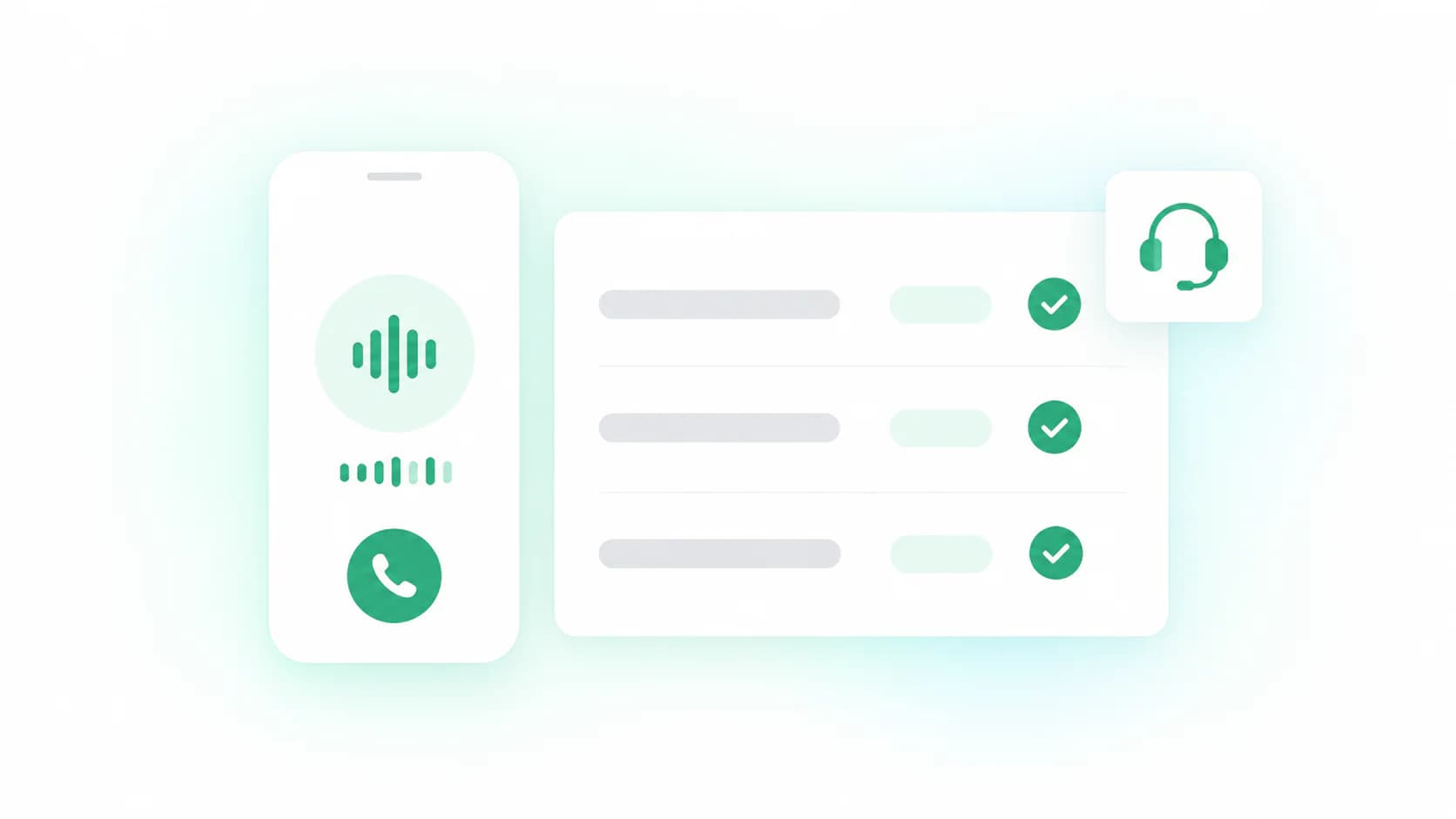
AI phone screening is a first-round screening interview that an AI voice agent runs instead of a recruiter. The agent asks your role's questions by voice, follows up when an answer is thin, answers basic questions about the job and hands the recruiter a transcript or report. A person then decides who moves on. It works best for high-volume roles with clear criteria, such as customer service and call center hiring.
The strongest evidence so far is a 2025 field experiment with 70,884 applications for customer service jobs. Applicants interviewed by an AI voice agent by phone received 12% more job offers than applicants interviewed by human recruiters, and human recruiters made every hiring decision (Jabarian and Henkel, arXiv).
What the field data says about AI phone screens
The largest field test of AI phone screening found that applicants interviewed by an AI voice agent got more job offers and started more jobs than applicants interviewed by recruiters. Brian Jabarian and Luca Henkel ran it with PSG Global Solutions, a recruitment firm that is part of Teleperformance. It covered applicants who applied between 7 March and 7 June 2025 for entry-level customer service jobs in the Philippines, for US and European clients. Applicants who passed an initial screen were randomly assigned to a human recruiter, an AI voice agent, or a choice between the two. The AI ran its interviews by phone, and human recruiters made every hiring decision.
| Result | Human recruiter | AI voice agent |
|---|---|---|
| Received a job offer | 8.70% | 9.73% (12% more likely) |
| Started the job | baseline | 18% more likely |
| Chose this interviewer, when given the choice | 22% | 78% |
| How natural the interview felt (applicant survey) | baseline | significantly less natural |
Applicants who picked the AI voice agent had significantly lower language and analytical test scores than those who picked a human, so a free choice changes who ends up in your AI queue. When each call started, the agent said it was an AI and that a human recruiter would review the interview and make the decision. After data collection ended, Jabarian took an unpaid role as chief economist at PSG Global Solutions, which the paper declares.
The result comes from one employer, one country and one job family. Treat it as a reason to run your own pilot. The Firstview AI Interviewer is one way to run that pilot: the candidate starts a live voice interview from a link instead of waiting for a call.
How an AI phone screen runs, step by step
A typical AI phone screen has seven steps. The details differ by vendor, so check each one in a demo.
- Invite. The candidate gets a call, a text, an email or a WhatsApp message with a time or a link. The tool can invite every applicant at once, so nobody waits for a recruiter's slot, and many tools let the candidate start straight away.
- Disclosure. The agent says it is an AI, says the call is recorded and explains what happens to the result.
- Knockout questions. Schedule, location, work authorization, pay range or a required certificate. These take 1 to 3 minutes.
- Role questions with follow-ups. The agent asks your questions in a fixed order and follows up when an answer leaves out the part you need, such as what the candidate did personally.
- Candidate questions. The candidate asks about the role. A good agent answers only with facts that you approved and says when a person will follow up.
- Close. The agent explains the next step and when the candidate will hear back.
- Report and decision. The recruiter reads the transcript or report, listens to the parts that matter and decides. Many tools also send the result to the applicant tracking system (ATS), so check where it lands before you start.
In the field study, a full human-led interview took 10 to 20 minutes. Keep the AI version in the same range. A screen that runs long usually means the agent is repeating questions or cannot hear the answers.
What the recruiter gets back: a sample report
The output is where tools differ most. Some return a single score. Others return a summary, a transcript and a recording. The useful kind ties every judgment to the candidate's own words, so a recruiter can check it in seconds.
Below is a sample for a fictional applicant. Firstview wrote it for this guide on the report structure of its AI Interviewer: a verdict for each criterion, the quote and the time behind it, contradictions with the CV, and the criteria the interview did not cover. It is not from a real interview.
Sample report. Fictional applicant, not a real candidate.
Role: Contact Center Agent (inbound billing) · Interview length: 14 minutes · Language: English, 2 questions in Spanish
Criterion Verdict Evidence Can work the posted schedule (rotating weekends) Met 01:12 "Yes, weekends are fine. I did rotating weekends at my last job." Stays calm with an upset caller Exceeded 04:40 "I let her finish, read the bill back to her line by line, and found the duplicate charge while she was still on the call." Explains a next step clearly Partial 07:05 Said a refund "takes a while" and did not give the caller a time frame. Answers in Spanish on billing questions Met 09:52 Answered both Spanish questions in full sentences. Uses the knowledge base before escalating Unclear Not covered. The answer moved to a different story.
- Contradicts the CV: the CV lists 2 years at the last employer; the applicant said "about a year and a half" at 02:30.
- Not covered: typing speed, experience with a ticketing system. Ask in the next round.
- Decision: none. A recruiter decides.
Run this check on any vendor's sample: pick 3 verdicts and find the words behind each. If a verdict has no quote and no time, nobody can verify it, and you will not be able to explain it to the candidate either.
Phone call or browser voice interview?
"AI phone screening" covers two different setups: the agent calls the candidate's phone, or the candidate opens a link and talks to the agent in a browser on a phone or laptop. Both are voice interviews. They differ in what the candidate needs and what the employer can check.
| Phone call | Browser voice interview from a link | |
|---|---|---|
| How the candidate joins | Answers or places a call | Opens a link from an email or message |
| What the candidate needs | Any phone | A browser and a microphone; mobile data or Wi-Fi |
| Missed contact | Retries by call or text; easy to overdo | The link waits until the candidate is ready |
| Screen and camera checks | Not possible | Possible on a desktop browser |
| Switching language mid-interview | Depends on the vendor | Depends on the vendor |
| Unknown caller ID | Calls from an unknown number can go unanswered | Not relevant |
Neither setup is better for every role. A phone call reaches candidates with no data plan. A link avoids unanswered calls and repeated follow-up calls. Choose the setup that fits your applicants, then test it with a few of them.
Where AI phone screening fits, and where it does not
AI phone screening fits roles where many applicants answer the same questions against clear criteria:
- customer service and call center agents;
- retail, hospitality and warehouse roles with shift and location requirements;
- early-career programs with hundreds of applicants for each intake.
It fits poorly where the first conversation is also a sales call for the role: senior hires, leadership roles and niche specialists. Those candidates usually expect to talk to a person, and the questions depend on judgment that a fixed script does not capture. For those roles, keep the recruiter call and use the AI for notes instead.
Rules to check before the first call
Before the first AI phone screen, check 4 rules: AI disclosure, the EU duties for hiring tools, local bias-audit and notice laws, and recording consent. Laws on AI in hiring change often, so check the current text with counsel before you launch.
- Tell candidates they are talking to an AI. The EU AI Act's transparency rules apply from August 2026. The European Commission summarizes them this way: with systems such as chatbots, "humans should be made aware that they are interacting with a machine so they can take an informed decision" (European Commission).
- Expect stricter EU rules for hiring tools. The Commission lists AI tools for employment, such as CV-sorting software, as high-risk. Its page says that from 2 December 2027 high-risk systems must meet strict obligations, including risk assessment and human oversight.
- Check local bias-audit and notice laws. In New York City, Local Law 144 prohibits the use of an automated employment decision tool unless it had a bias audit within one year of use, the audit information is public and the required notices went to candidates (NYC Department of Consumer and Worker Protection).
- Say that the interview is recorded. Do it at the start, and confirm with counsel what consent each of your locations needs for a recording.
Two more practices are worth adding even where no law asks for them: offer a human alternative to candidates who ask for one, and give candidates who need an accommodation a direct contact.
What to ask an AI phone screening vendor
An AI phone screening vendor should answer these 9 questions, and show each answer in the product:
- What exactly does the agent say in the first 15 seconds?
- Does the tool ever reject or advance a candidate on its own? Who makes the decision?
- Is each result tied to the candidate's words and the time they said them?
- Which languages and accents did you test, and can we test with our own staff first?
- Can the candidate pause, ask for a repeat or skip a question? What happens when the call drops?
- How many times does the tool contact a candidate who does not answer, and can we set the limit?
- How long are recordings and transcripts kept, and is candidate data used to train models?
- Can we export results by group to check pass rates for adverse impact?
- Where do the results go: into our ATS, or only into your own system? Can we see that working with our ATS in the demo?
How to run a 2-week pilot
A 2-week pilot on one high-volume role is enough to compare the AI screen with your recruiters. Have the AI screen every applicant, and have a recruiter also screen a sample of 30 of them without seeing the AI's report. Then compare:
| Metric | What it tells you |
|---|---|
| Completion rate | How many invited candidates finish the screen |
| Drop-off by question | Which question makes candidates hang up or close the link |
| Time from application to first interview | Whether candidates wait less |
| Agreement with the recruiter | On the 30 double-screened candidates, how often both reach the same decision |
| Pass rate by group | Whether the screen passes some groups less often |
| Unanswered candidate questions | What the agent could not answer and a person had to |
Read 10 full transcripts as well. They show what the metrics miss, such as an agent that interrupts candidates or repeats a question.
How Firstview runs the first-round screen
Firstview's AI Interviewer runs the first-round screen as a live voice interview. It does not place phone calls. You invite one candidate or a whole stage by email or WhatsApp, and each candidate starts from a link on a phone or laptop whenever they are ready, in any of 42 languages.
- It asks your questions and asks up to 2 follow-up questions, only for the part of an answer that is missing.
- Candidates can pause, ask for a repeat or skip a question, and have 5 minutes to rejoin after a dropped connection.
- It answers questions about the role with the facts you approved. When it does not know an answer, it tells the candidate that HR will follow up.
- The report gives a verdict for each criterion with the candidate's words and the moment in the recording, flags anything that contradicts the CV, and lists the criteria the interview did not cover.
- It never asks about age, family, health or religion, and the name is removed before the report.
- It does not decide who moves on. A person does.
The integrity rules (screen sharing, camera, one screen) apply in full on a desktop browser. For contact center hiring, the call center page shows how a second-language check runs inside the same interview.
How we made this guide
We read the top 5 Google results for "ai phone screening" (from Semrush, US, October 2026) and the full text of Jabarian and Henkel's field experiment (arXiv, version 2, September 2026). We checked the regulation points on the European Commission's AI Act page and the New York City DCWP page. The sample report is fictional: Firstview wrote it on the report structure of its AI Interviewer, with no customer or candidate data. No person has reviewed this guide yet.