Campus Recruitment: An Employer's Plan for 2026-27
Plan campus recruitment as an employer: 2026 NACE and ISE numbers, a recruiting calendar, the math from places to applications, and a sample rubric.
Nov 1, 2026 • 13 min read
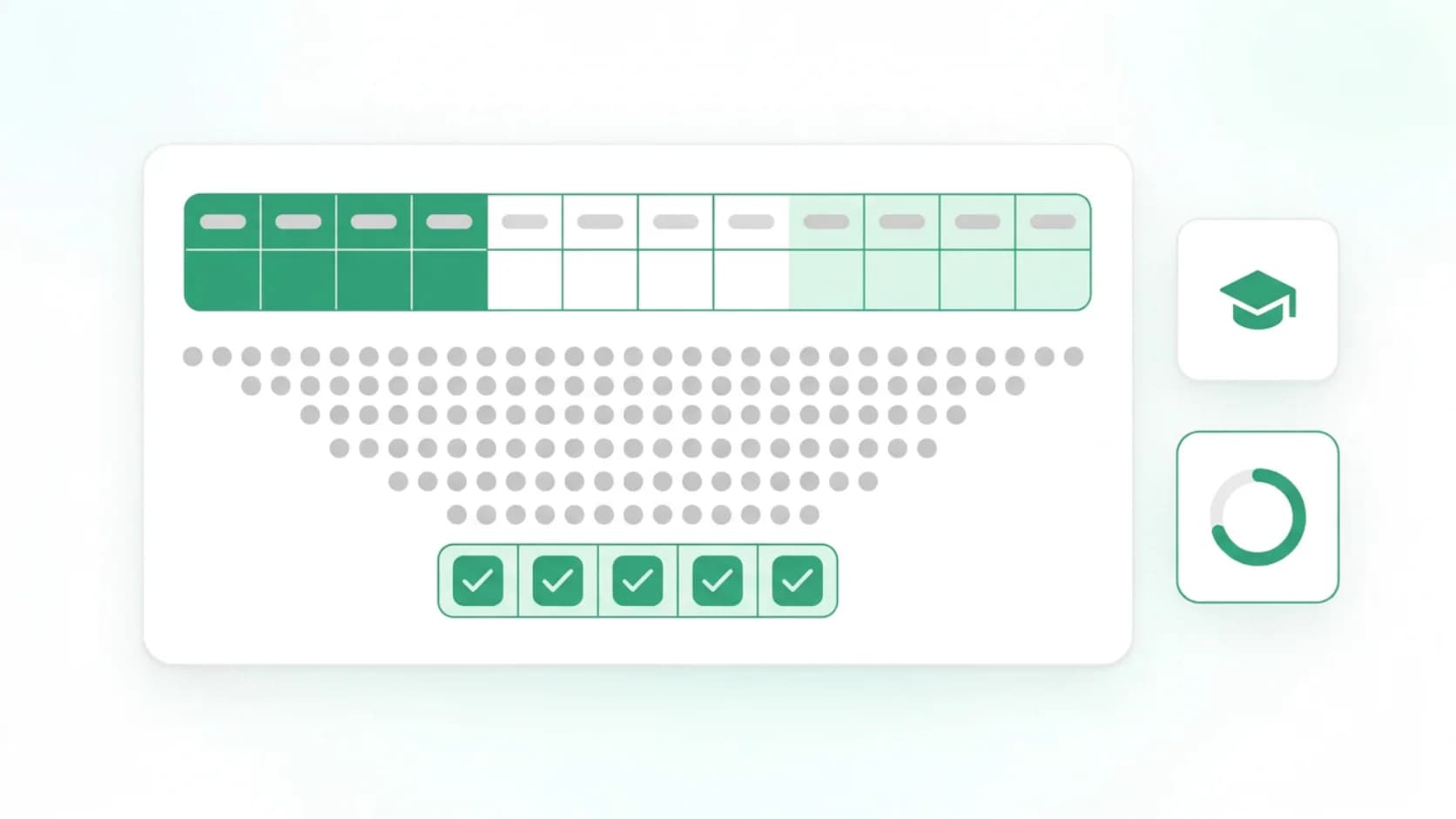
Campus recruitment is how employers find, assess and hire students and recent graduates for internships and entry-level programs. In 2026 the UK's Institute of Student Employers (ISE) counts 141 applications per graduate role, and US employers in NACE's latest benchmark survey took an average of 40.5 days from a student's first interview to an offer or a rejection. A campus recruitment plan therefore starts from your number of places, works back to the number of applications you must handle, and fixes the criteria and the timeline before the first career fair. The season then runs in order: choose schools and online channels, tell students what the program offers, give every applicant the same first interview, run assessment days with one scorecard, and make offers within days.
Campus recruitment numbers for 2026
The latest US and UK surveys show more hiring, more applications per place and slower decisions than a few years ago. Use these numbers as the base for your own plan:
| Measure | Number | Source and sample |
|---|---|---|
| Applications per graduate role (UK) | 141 (London: 172) | ISE Student Recruitment Report 2026, 155 employers, 2025/26 cycle |
| Change in graduate hiring (UK) | +4% in 2025/26, after an 8% fall | ISE 2026, same sample |
| Change in new-graduate hiring (US) | +5.6% for the Class of 2026 | NACE Job Outlook 2026 Spring Update, 185 employers, February to March 2026 |
| Days from first interview to offer or rejection (US) | 40.5, up from 27.3 | NACE 2026 Recruiting Compensation + Staffing Benchmarks, 175 member and 42 nonmember employers, April to June 2026 |
| Offers accepted (US) | 76.3% | NACE 2026 benchmarks, same sample |
| Days a student takes to answer an offer (US) | 11, up from 9 | NACE 2026 benchmarks, same sample |
| Interns who become full-time hires (US) | 63.1% for 2024-25 interns | NACE 2026 Internship & Co-op Survey, 284 organizations, October 2025 to January 2026 |
| Offer acceptance among interns (US) | 88.3% for 2024-25 interns | NACE 2026 internship survey, same sample |
| Employers who suspected or confirmed student misconduct in selection (UK) | 92% | ISE 2026 |
Two of these numbers set the shape of the plan. With 141 applications per place, the screening step decides your workload. At the NACE averages, 40.5 days pass between a first interview and the employer's decision, and a student then takes 11 days to answer an offer.
If you screen intern and graduate applicants at this volume, Firstview's campus recruiting software gives every applicant the same first interview, judged by one program rubric, and a person decides who moves on.
Campus recruiting calendar: when to recruit
Campus recruiting in the US runs in a fall window and a spring window, and the spring window is growing. Cornell's career office gives typical dates for on-campus recruiting: "Typically, campus recruiting occurs in the fall, from approximately the first week of September until the first week of December, and in the spring, from the first week of February through April." In NACE's Job Outlook 2026, the percentage of recruiting that takes place in the spring stands at 37% for full-time hires and 27% for interns, and it is increasing. Before the pandemic, nearly three-quarters of full-time recruiting was done in the fall.
| Months | Main work for the employer |
|---|---|
| June to August | Set the places per program, write the criteria and the rubric, book fairs and talks with career services |
| September to early December | Fall fairs and talks, applications open, first interviews, assessment days |
| December to January | Fall offers out, keep in touch with students who accepted, review the fall numbers |
| February to April | Spring fairs for the places still open and for summer interns |
| May to August | Interns on the job; collect their evidence for full-time offers |
Offers come earlier than before. NACE's 2026 benchmark survey found that 59% of offers to the Class of 2025 were made in fall 2024, compared with 52% a year earlier. If your competitors make offers in the fall, a plan that interviews in the fall and decides in the spring can lose students to them.
How to plan a campus recruitment season in 8 steps
A campus recruitment season is a fixed project: one start date, a known number of places and a deadline for every stage. Plan it in this order:
- Set the places and the offers. Count the places for each program, then divide by your offer acceptance rate to get the offers you need. At NACE's average acceptance of 76.3% for new graduates, 40 graduate places need about 53 offers. For your own interns, NACE's separate internship survey reports an acceptance rate of 88.3% among 2024-25 interns.
- Choose your schools and channels. Start from the roles: list the courses and skills each program needs, then pick the universities that teach them, near the offices where the graduates will work. Check which schools your strongest past hires came from. Agree with each career services office which fairs, talks and interview days you will attend, and bring people who work in the program to the fairs along with the recruiters. Give every stand and talk one short link to the application, so a student can apply on the day. Add online applications and virtual events for students at schools you do not visit.
- Tell students what the program offers. Say what the work is, the pay range, where the program is based and what comes after it. Let graduates who joined in earlier years describe their first year in their own words, at talks and on your careers page.
- Write the criteria and the rubric before the first event. Define 3 to 5 criteria that predict success in the program, and write what strong and weak answers sound like for each one. The structured interview guide shows how to write the questions, and the free interview guide builder has role-based question sets you can edit.
- Publish the timeline to applicants. Tell students the dates of each stage and when they will hear back, then keep to those dates.
- Give every applicant the same first interview. Ask the same questions in the same order, rate each answer against the rubric, and let a person decide who moves on. Students with little work history can answer situational questions about school projects, part-time jobs and volunteering.
- Run assessment days with one note template. Every interviewer fills the same interview scorecard on the day, so the panel compares the same evidence for every candidate.
- Make offers quickly and stay in touch until the start date. Send offers within days of the final stage, keep accepted students informed until they start, and keep a record of each intern's work so the full-time decision starts from evidence.
How many applications to plan for
The number of applications follows from your places and the applications per place, and the number of first interviews follows from your pass rate at the application stage. Firstview wrote the sample below for this guide: the places are fictional, the stage pass rates are assumptions for the example, and only the 141 applications per role and the 76.3% acceptance come from the surveys above. The sample counts each place as one graduate vacancy, as ISE does, and it mixes a UK application rate with a US acceptance rate, so replace both with your own numbers.
Sample: a retail operations graduate program with 40 places.
| Step | Calculation | Result |
|---|---|---|
| Offers needed | 40 places ÷ 76.3% acceptance | 53 offers |
| Applications to expect | 40 vacancies × 141 applications per vacancy | 5,640 applications |
| First interviews | 5,640 × 30% pass the application check (assumption) | 1,692 first interviews |
| Assessment day places | 1,692 × 20% pass the first interview (assumption) | 338 candidates |
| Offers from assessment days | 53 ÷ 338 | 16% of assessment day candidates get an offer |
| Recruiter time, if the first interview is a recruiter call | 1,692 × (20-minute call + 10 minutes of notes) | 846 hours |
846 hours is about 21 weeks of one recruiter's 40-hour weeks, and the fall window is about 13 weeks long. The team must grow for the season, or the first interview must take less recruiter time. A lower pass rate at the application stage also cuts the hours, but good students with thin CVs drop out with it. Put your own numbers into the screening time calculator to see your hours.
Sample program rubric and evidence summary
A program rubric names the criteria for the whole intake and describes what each verdict means, so every interviewer judges the same way. Sample: Firstview wrote the program, the applicant and the answers below for this guide; they come from no real applicant or customer. The format follows Firstview's evidence report: one verdict per criterion, the applicant's own words and the moment in the interview when they said them.
PROGRAM RUBRIC (SAMPLE)
Program: Retail operations graduate program, 40 places
Verdicts: Exceeded / Met / Partially met / Not met / Unclear

1. Plans and prioritizes work
   Strong: names a real deadline, what they dropped or delayed, and why
   Weak:   "I just worked harder" with no example
2. Explains numbers simply
   Strong: states the number, then what it means for a decision
   Weak:   reads numbers out with no conclusion
3. Takes ownership
   Strong: acted on a problem nobody assigned to them, and says what happened next
   Weak:   describes only tasks they were given
4. Works with customers or the public
   Strong: a specific difficult moment and what they said
   Weak:   general statements about "loving people"

EVIDENCE SUMMARY (SAMPLE: fictional applicant)
Applicant: Maya Ortiz        First interview: AI interview, 19 min, English

1. Plans and prioritizes work: Met
   06:12 "Exam week and two Saturday shifts. I swapped one shift a month
          ahead and told my manager why."
2. Explains numbers simply: Exceeded
   08:40 "Our society's event lost money. I showed the committee one number,
          cost per guest, and we cut it from $14 to $9."
3. Takes ownership: Partially met
   11:05 Fixed the store's out-of-date shelf labels when asked by the
         supervisor; no example of acting without being asked.
4. Works with customers or the public: Unclear
   13:30 Answer described a team conflict, not a customer.
   Goes to a person: ask a customer follow-up at the assessment day.

Program team decision (made by a person): invite to the assessment day.
In the sample, an answer that fits no verdict (Unclear) goes to a person with a note on what to ask at the next stage. In Firstview, the same rubric applies to every applicant, protected topics are never asked, and names are removed before reports.
How to keep first interviews fair when applicants use AI
Students now use AI to write applications, and employers report more misconduct in selection. In the ISE 2026 report, 92% of employers suspected or confirmed student misconduct in assessment and selection processes, compared with 85% in 2025. The same report found that 82% of employers give students guidance on acceptable and unacceptable use of AI, up from 55%, and that 77% are reviewing or redesigning their processes.
Make these changes to the first stage:
- Say what is allowed. Tell applicants in the job post which AI use you accept for the CV and the cover letter, and that the interview must be their own answers.
- Ask follow-up questions. A follow-up question on the same example shows whether the student did the work.
- Weigh the interview more than the CV. Most students have little work history, so their interview answers carry most of the evidence.
Firstview's AI Interviewer runs a live voice interview in 42 languages and applies integrity rules while the interview runs: if a rule breaks, the interview pauses and the candidate has 4 minutes to fix it. Anything unclear goes to a person, and a person makes every decision. On a phone, the screen-share and full-screen checks cannot run, and no check can see a second device, so the checks reduce cheating but do not prove that none happened. ISE found that only 16% of employers use AI in recruitment today, and 29% plan to introduce it within the next year, so a pilot on one program is a normal first step.
Campus recruitment metrics to track
The metrics that matter for campus recruitment show where students drop out and how long each step takes. Track them for each program and compare them with last season:
| Metric | How to calculate it | Benchmark |
|---|---|---|
| Applications per place | Applications ÷ places (1 place = 1 vacancy) | ISE 2026 (UK): 141 per graduate role |
| First interview completion | Applicants who finish the first interview ÷ applicants invited | Your last season |
| Days from first interview to decision | Average days from first interview to offer or rejection | NACE 2026 (US): 40.5 days |
| Offer acceptance | Offers accepted ÷ offers made | NACE 2026 (US): 76.3% |
| Days to answer an offer | Average days from offer to the student's answer | NACE 2026 (US): 11 days |
| Intern conversion | Interns of one class who become full-time hires ÷ interns in that class | NACE 2026 (US): 63.1% for 2024-25 interns |
For the stage-by-stage view across all roles, see the hiring funnel benchmarks.
How to shorten the time from first interview to offer
The time from first interview to offer gets shorter when each stage has a deadline and the evidence is ready before the decision meeting. Four habits help:
- Book the assessment days before applications open, so a candidate who passes the first interview gets a date the same week.
- Agree in advance who decides for each program, and the date of each decision meeting.
- Bring written evidence to the meeting: the rubric verdicts and the quotes behind them.
- Send the decision to every candidate, including the rejections, on the date you published.
At NACE's 2026 averages, a team that cuts the 40.5 days to 20 days gives students about 3 weeks less to accept another employer's offer.
How we made this guide
We read the top US search results for "campus recruitment" and "campus recruiting strategy" (3 HR software guides, a recruiting platform's employer guide and a university career office page) and the primary sources for the numbers: NACE's Job Outlook 2026, its Job Outlook 2026 Spring Update, its 2026 Recruiting Compensation + Staffing Benchmarks and its 2026 Internship & Co-op Survey, the ISE Student Recruitment Report 2026 summary on ise.org.uk and Cornell University's campus recruiting page. The program, the stage pass rates, the rubric and the applicant are fictional: Firstview wrote them for this guide, and they come from no real applicant or customer. The product details come from Firstview's campus recruiting and AI Interviewer pages. No named person has reviewed this guide yet.